The 4 step algorithm to making your first hires
When I went to hire my first person at Column Tax, Erik Goldman (co-founder of Vanta) shared this 4 step algorithm that I used and had all hiring managers who worked with me use as well. I've shared it with all of the startups I've advised, and wanted to memorialize it publicly online.
Intro
At some point, hiring becomes your most important job as a founder. After you've found PMF, hiring is likely your biggest job. Your team is your company. And your people will bottleneck your progress if you don't hire well. On the flipside, hiring someone amazing who can take work off your plate is the best feeling ever. Here's how to do it.
How do you know when you need to hire?
First, how do you know you need to hire? The test you can use is to ask yourself "Do you wish you had a replica of yourself to do known work you have?" -- if your answer is "yes", it's probably time to hire. If you can't easily explain the work you need to do (e.g. it's to find initial PMF or is something you haven't yet done yourself), it might be too early.
One corollary to this: most hires come too late. If it takes 3-6 months to hire someone and 3 months to ramp them up, you're at a minimum 6 months away from having someone productive in-seat from the moment you decide to start hiring. For that reason, it's occasionally beneficial to try to make a hire join "too early". By doing that, you might just get a hire to join on-time.
4-step algorithm
Here's the 4-step algorithm to create a rubric and interview loop once you've decided to hire:
- Write down what the person will be doing for the next 6-12 months (with a heavy emphasis on the 6 part)
- Write down a list of questions you'd need to say yes to in order to feel comfortable bringing them on ("can they manage projects without a full-time PM?", etc.)
- Group1 the questions into related groups and give those groups descriptive titles: these are your hiring traits. If you have more than three of them, you're not going to find someone and you need to pare back your expectations for the hire.
- Write interviews that, when summed together, give overlapping signal on the hiring traits (assume that a good candidate will randomly flub one interview for no reason -- you should be resilient to that) and answer the questions to produce a yes/no.
- (Projects can be interviews!)
Example: Product Manager
Example rubric
Here's an example rubric I made for a recent PM hire:
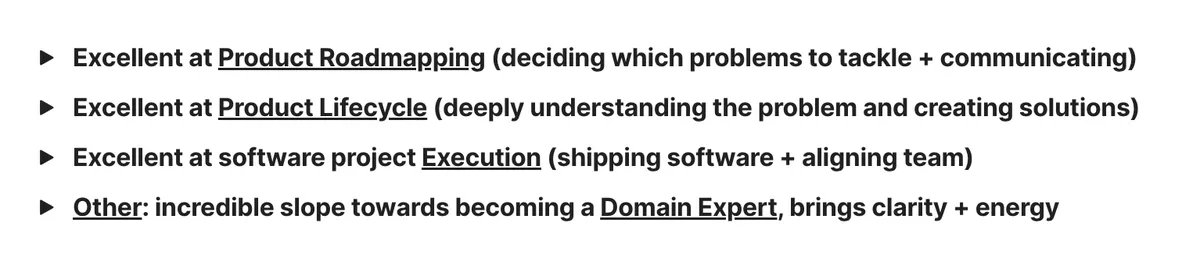
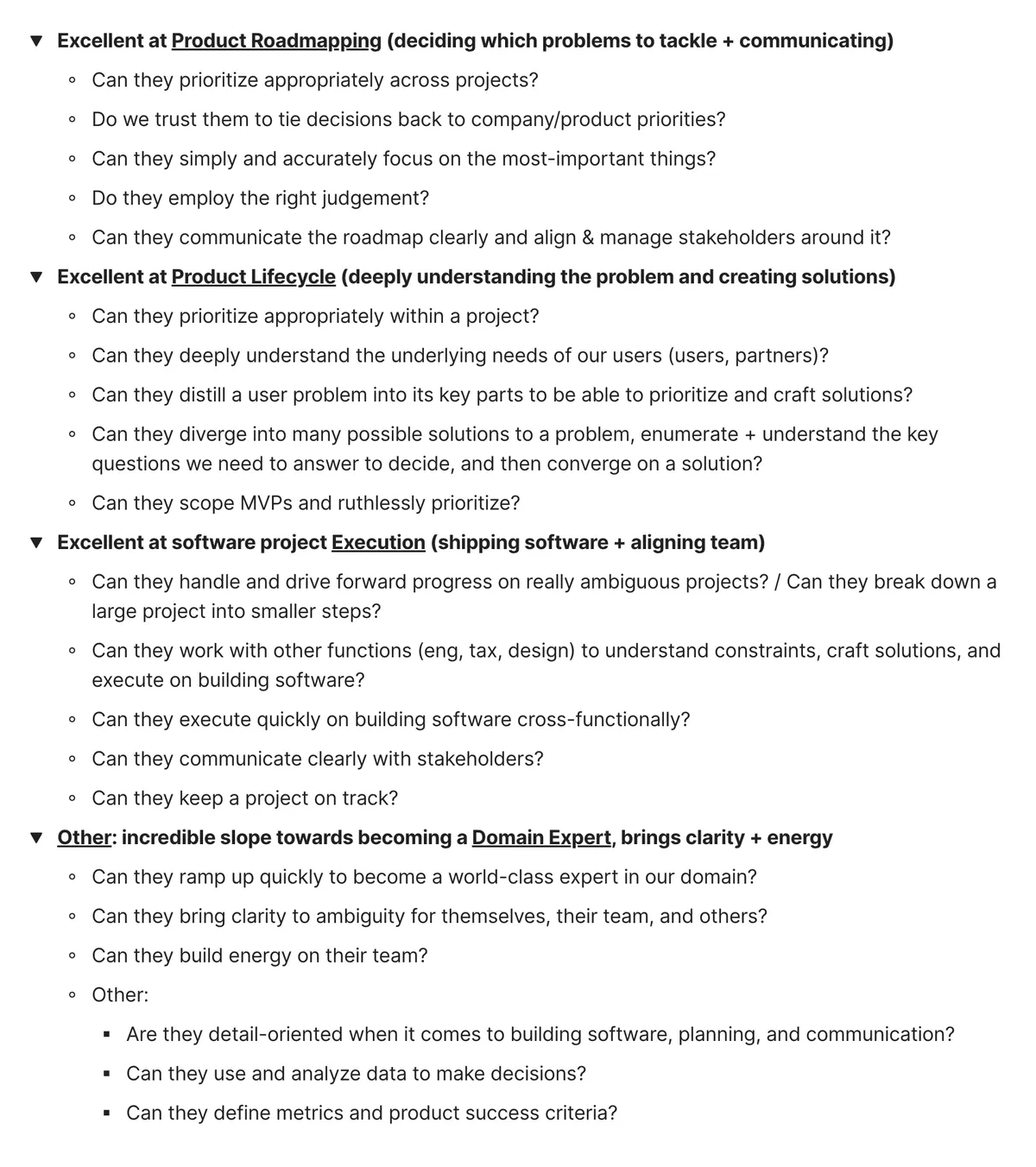
Example full question set consolidated into rubric
And here's the full set of questions I listed out that collapsed into those hiring traits.
Example interview loop for a PM
Here's the interview loop I created to assess candidates against that rubric:
- (30 minutes) Intro call
- (60 minutes) Behavioral interview
- Traits covered: Roadmapping, Lifecycle, Execution, Other
- Written Work Artifact
- Traits covered: Other
- Onsite Interview or Work Trial
- (60 minutes) Product Project Show & Tell
- Traits covered: Roadmapping, Lifecycle, Execution, Other
- (3 hours) Product Onsite Project
- Traits covered: Lifecycle, Execution, Domain Expert/Other
- (60 minutes) Product Project Show & Tell
- References + Offer
Work trials
- Work trials are your best method for interviewing because you actually get to work with candidates on real work.
- When you do a work trial, you still need to assess the candidate against your rubric.
- How to run work trials?
- A 1 week full-time equivalent work trial is usually enough time to assess a candidate.
- Pick a project that would take a ramped-up person ~2 days to do and give the person 4 days (because they have to ramp up on lots of context).
- Pay people for their time! Doesn't have to equal the FT equivalent. $75-150/hr is standard.
- You should be ready to do "normal" interviews with folks who e.g. have a full-time job and can't take off to do a work trial.
Culture
- It can feel too early to think about culture when there's so much raw work to do in the early days of a startup.
- If you skip proactively thinking about culture, "culture" will happen naturally: employees will create their own culture, and you might not like it.
- I've personally made the mistake of hiring someone great who was not a good culture fit and that began to set our culture. New hires learn culture from others, especially early employees.
- I recommend spending some dedicated time on writing down your Operating Principles.
Hiring tactical tips
Sourcing
- There are lots of options for how to source candidates but no magic bullets (except building a world-class hiring brand that brings in inbound candidates). So you need to experiment with many sourcing techniques and find what works for you.
- Your best source is likely in-network--hiring people you know or have worked with in the past.
- You should also keep a spreadsheet of top talent you want to catch up with every 3-6 months (until their timing is right).
- Cold sourcing takes some effort to set up, but can work (it's a numbers game).
- Contingent recruiters are another option. Find someone good. They charge ~20%, unfortunately; that's just the going rate.
Interviewing & Comms Etiquette
- Lay out the process for the candidate upfront so they know what to expect. Nothing in the process should be a surprise to the candidate!
- Follow up quickly.
- Don't ghost candidates!
- How buttoned-up your process is will impact your ability to close.
- Ask if there are any references you should not contact.
References
- Make References a default & important part of the process: tell candidates upfront you'll do them later in the process.
- Here's how to run a reference call: https://jackealtman.com/reference-checks/
Comp
- Use benchmarks (Pave, etc.) to find standards and create your offers.
- Consider offering two options (Cash-heavy and equity-heavy). Picking between two options reframes the choice away from yes/no.
Negotiating
- Be fair: don't let people who negotiate harder make more.
Closing
- Closing begins the moment your interactions with the candidate start (and even before!)
- Only give an offer once the candidate is ready. Before giving an offer, ask if they will accept assuming you can figure out comp. If they say no, fix that objection first.
- Go all out with closing: go big with a big gesture (flowers, dinner, handwritten cards, videos, etc.) and bring in your extended supporters (e.g. investors, advisors) to help too.
- See https://startuphiring101.com/6-selling-closing for more on closing.
Other tips from experience
- Always interview! Don't make the mistake of skipping an interview process.
- Only hire for roles you're actually hiring for. Make sure you put everyone through a (well-thought-out) interview process.
- Only hire friends if you're willing to lose the friendship (if it doesn't work out).
- Timing is everything. Eventually, someone you want to hire might be ready to switch roles and you want to be top-of-mind at that moment. Do this by keeping in touch directly with high-value folks and/or having some frequency of posting on social.
- Finding people who can work across >1 discipline (e.g. product + engineering, design + product) is incredibly hard. Don't expect it. And if you find someone like that, hold on tight and give them lots of responsibility, regardless of their past experience/level/title.
- If they could do [what you do as a founder], you'd be working for them, not the other way around.
- The big difference between founders & employees is the amount of ambiguity you can handle.
- It's better to be polarizing in recruiting messaging: attract people who fit your culture and actively dispel those who don't. e.g. if your company works many hours, don't advertise work-life balance as a recruiting selling point and reject anyone who mentions WLB during the hiring process.
- You have to always be recruiting, even if it feels constraining on your time.
- Make sure you find evidence in your interview process of being able to work at startup speed if someone has only worked at BigCos before.
- You'll never successfully recruit someone who is considering you + AmaFaceGoogSoft. If someone is considering you + BigCo, make them make that decision before continuing the interview process.
- Sometimes if you feel like you're pushing too hard on getting a potential hire to sign with you, you might be making a mistake and they'll end up quitting quickly anyway. Use the anti-sale strategically.
- Lots of things you don't think of as "skills: are actually skills just like coding: people management, leadership, influence, interpersonal effectiveness, leading larger teams/projects. (e.g. your VPE should be able to do the last one really well.)
- So you can create rubrics & interview for these just like any other skills.
- Always interview! Don't make the mistake of skipping an interview process.
Thanks to Hannah Squier and Michael Mattheakis for reading & providing great feedback on drafts of this post.
To get notified (extremely rarely) when I publish a new post, subscribe here:
I'm not sure if this is too obvious to mention, but feel free to use AI to help you do this!↩